Preview

Through an intimate portrait of the people who run a unique nonprofit emergency disability service in Berkeley, and members of the disability community fighting for adequate care to live independently, AS YOU CHOOSE is a perceptive exploration of how systemic underinvestment limits societal equality.

About the Film
Easy Does It in Berkeley is the only emergency disability service nonprofit in the country. It doesn’t deal with life threatening emergencies like heart attacks— they respond to the type of emergency someone in a wheelchair might experience: they’ve fallen out of their wheelchair and can’t get back in it; their caregiver is sick and they’re stuck in bed; their motorized wheelchair breaks down in the grocery store, and they’re suddenly and unexpectedly stranded.
These are issues that happen in Oakland just as much as Berkeley, but at the Berkeley border, most of the EDI services stop. Funded by a property tax measure passed by Berkeley residents, EDI only has the funding to offer their unique services to Berkeley, namely emergency caregiving services.
Bruce Curtis hopes to change that. He’s in talks with Oakland about a partnership, but providing on-call caregivers is expensive and without guaranteed funding, Bruce knows it will not work. How will he expand EDI’s services to neighboring cities without undermining the organization? With observational camerawork, we follow Bruce as he uses his position to try to expand services while maintaining the strength and financial feasibility of EDI.
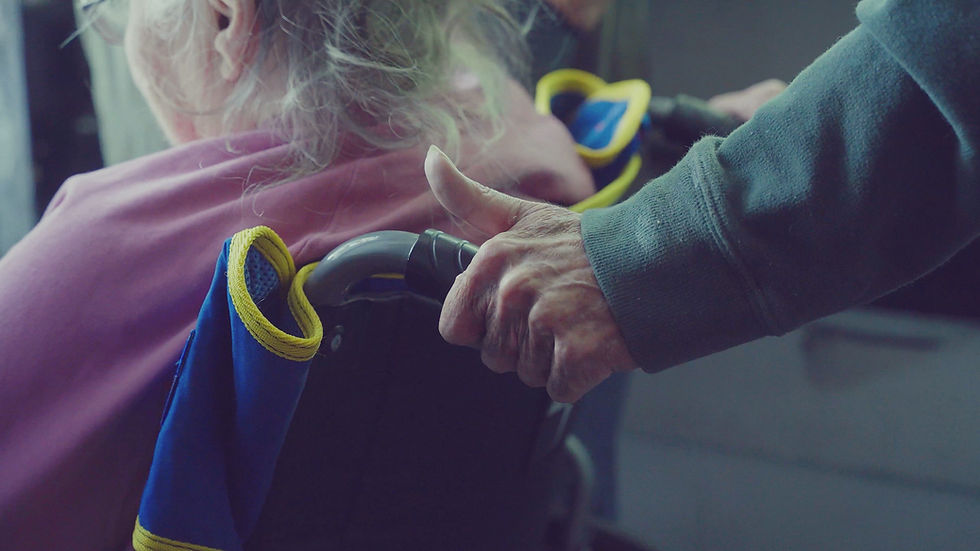
Woven into the character profiles are verité scenes of Berkeley community members receiving emergency services. At times harrowing, or heartfelt, these vignettes will show how EDI has become an essential service in the Berkeley community.
Style
AS YOU CHOOSE is a lyrical character-driven documentary grounded intimately in four participants’ lives, and the artistic approach is observational cinema verité, paired with beautiful portrait interviews, and archival footage.
Stylistically, the camerawork is observational and matter-of-fact; through composition the visuals are beautiful, but no devices or metaphors for disability will be employed. The goal is to not obscure the realities of going through life with a physical disability, nor to sensationalize it. The goal is to make the audience feel like they’re in the room.